A large detailed map of British Columbia
This is a large, detailed map of British Columbia. There are links to many British Columbia localities below. Our website format reduces the display size for uniformity. Here is a link to the full-size image that is more easily readable.
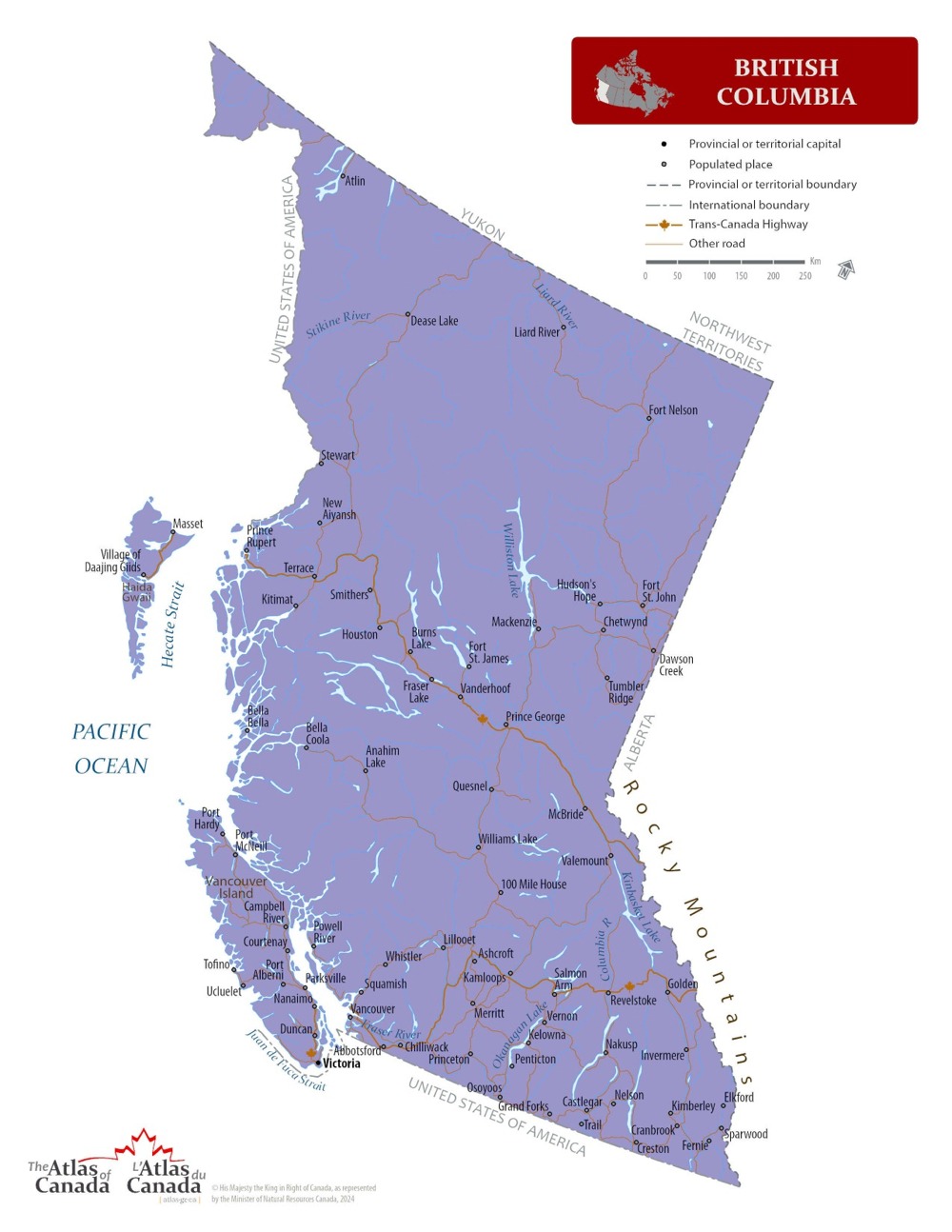
Map © Natural Resources Canada / Government of Canada
British Columbia — Interactive Map
Explore British Columbia with an interactive map featuring Street View, satellite and terrain views. Live weather, local news and location details for British Columbia — built for travel planning and emergencies.
Map search is available for a limited number of queries per session to manage costs. Be specific — search precisely for best results.
| Province / Territory | British Columbia (BC) |
| Capital | Victoria |
| Largest City | Vancouver |
| Country | Canada |
| Nickname | Beautiful British Columbia |
| Latitude | 53.7267 |
| Longitude | -127.6476 |
| Population | 5,000,879 |
| Cities & Towns | 1,715 |
| Area | 944,735 km² |
About British Columbia
British Columbia defines itself through an immense, vertical drama of geography, where the restless Pacific Ocean meets the rigid, snow-crowned spines of the Coast Mountains. From the dense, temperate rainforests of the western islands to the high, arid plateaus of the interior, the terrain shifts with a sudden, startling violence of scale. Great rivers like the Fraser and the Skeena cut deep, winding gashes through the bedrock, carving paths that have dictated the movement of life for millennia. The central heartland of British Columbia is a rugged, quiet expanse of pine-shadowed valleys and glacial lakes that hold the cold light of the northern sky. Glaciers linger in the high basins, while the coastal reaches maintain a soft, damp climate that fosters a verdant, moss-heavy wilderness. This landscape possesses a singular, imposing gravity that forces the traveller to acknowledge the sheer weight of the earth.
Indigenous peoples have served as the primary stewards of British Columbia since time immemorial, maintaining sophisticated social structures and deep relationships with the coastal inlets and river systems. European interest arrived later, initially driven by the maritime fur trade and the promise of gold, which eventually pulled the region into the broader colonial orbit of the British Empire. The formalization of borders and the subsequent joining of Confederation transformed a collection of remote trading posts and frontier settlements into a cohesive political entity. Today, British Columbia reflects a complex history of resource extraction, sudden booms, and the ongoing, vital work of reconciliation with those who first held the land. The modern character of the province is a direct result of these layered transitions, balancing the legacy of colonial expansion against the enduring presence of original inhabitants.
Resource extraction serves as the traditional backbone of British Columbia, with forestry, mining, and hydroelectric power providing the momentum for its regional development. The ports of the coast act as massive, salt-sprayed gateways to the global market, funneling timber and minerals toward the horizon while anchoring the economic stability of the province. Agriculture thrives in the fertile, sun-drenched valleys of the south, where orchards and vineyards produce a bounty that defines the local palate. Vancouver stands as the primary urban engine, a dense concentration of commerce and glass-fronted towers that overlooks the churning harbour. Meanwhile, secondary hubs across British Columbia continue to manage the flow of goods and services, ensuring that the wealth generated from the earth reaches the wider world. Industry here remains tied to the physical realities of the terrain, reflecting a constant negotiation between human necessity and the vast, demanding wild.
Sports and cultural expression in British Columbia are marked by a deep, almost seasonal engagement with the outdoors, from the winter slopes of the interior to the summer sailing culture of the coast. The Vancouver Canucks represent the province on the national stage in the NHL, drawing a fervent following that mirrors the regional intensity of local life. Festivals celebrating the arts, film, and the harvest cycles of the Okanagan valley draw citizens together, fostering a sense of community that persists despite the rugged, isolating geography. Culinary traditions here emphasize fresh, locally sourced ingredients, often highlighting the salmon and berries that have sustained people for generations. Daily life in British Columbia is characterized by an understated confidence, a habit of moving easily between the high-pressure demands of the city and the restorative silence of the backcountry. This balance creates a distinct identity that is both cosmopolitan in its outlook and fiercely protective of its natural heritage.
British Columbia Cities, Towns and Communities
#
A
B
C
D
E
F
G
H
I
J
K
L
M
N
O
P
Q
R
S
T
U
V
W
X
Y
British Columbia Maps — Interactive Map, Street View, Weather & News
This page provides an interactive Google map of British Columbia (BC) with Street View, satellite and terrain views, alongside links to detailed street maps for 1,715 cities, towns and communities across the province. The provincial capital is Victoria.
Every location page includes live weather through Open-Meteo — with current conditions, hourly outlooks and 7-day forecasts — alongside real-time local and world news feeds. Editorial summaries and location descriptions are included where available, and visitors can search Google directly from each page for additional context.
Location data is sourced from the Canadian Geographical Names Database (CGN), Natural Resources Canada, and verified by coordinates rather than name matching alone.