A large detailed map of Nunavut
This is a large, detailed map of Nunavut. There are links to many Nunavut localities below. Our website format reduces the display size for uniformity. Here is a link to the full-size image that is more easily readable.
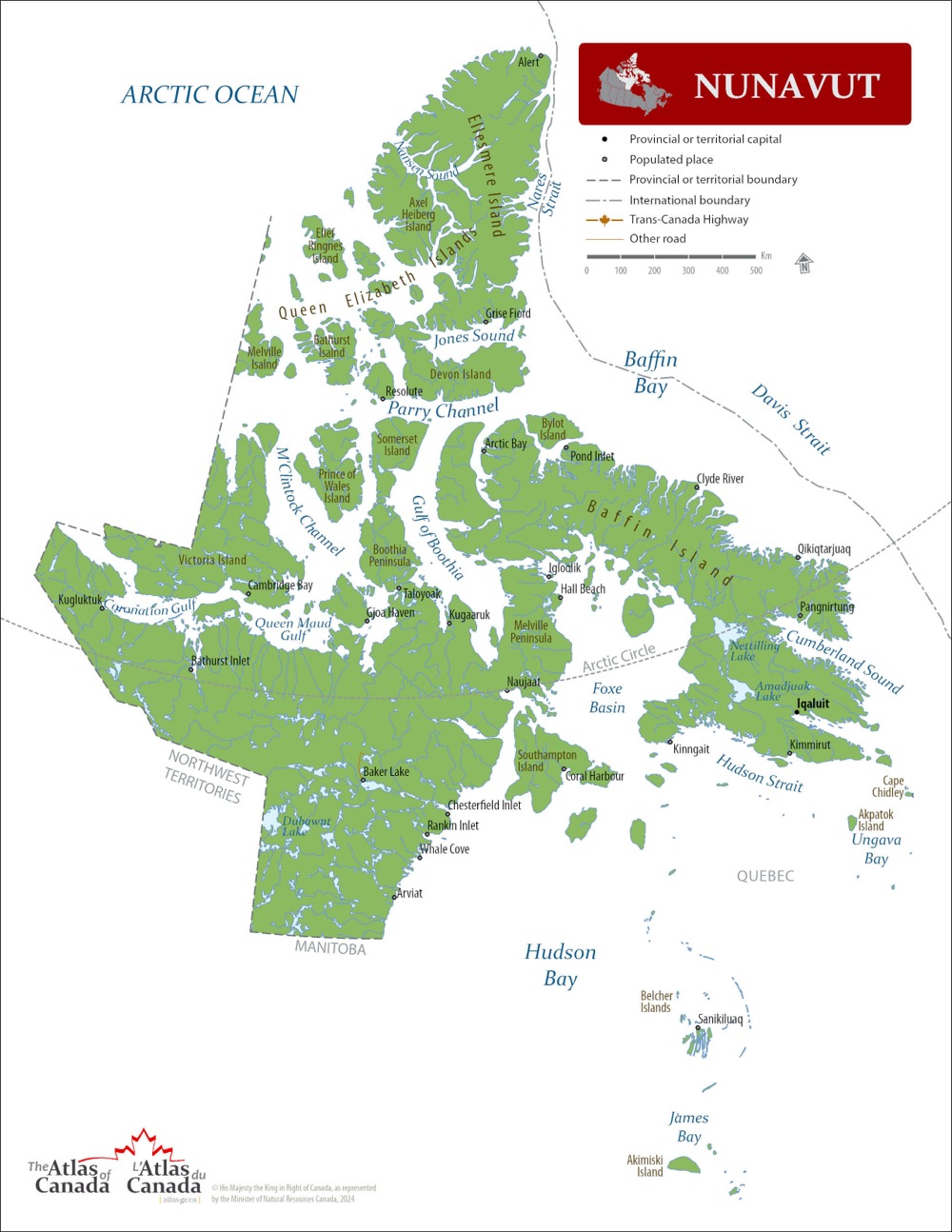
Map © Natural Resources Canada / Government of Canada
Nunavut — Interactive Map
Explore Nunavut with an interactive map featuring Street View, satellite and terrain views. Live weather, local news and location details for Nunavut — built for travel planning and emergencies.
Map search is available for a limited number of queries per session to manage costs. Be specific — search precisely for best results.
| Province / Territory | Nunavut (NU) |
| Capital | Iqaluit |
| Largest City | Iqaluit |
| Country | Canada |
| Nickname | Our Land |
| Latitude | 70.2998 |
| Longitude | -83.1076 |
| Population | 36,858 |
| Cities & Towns | 67 |
| Area | 2,093,190 km² |
About Nunavut
Nunavut spreads across a vast, frozen expanse where the horizon pulls the eye toward an infinite, pale distance. The land near the heart of the region presents a rugged architecture of ancient rock, where permafrost anchors a terrain largely devoid of deep-rooted trees. Massive, winding fjords cut through the eastern coast, carving deep channels where the sea ice groans under the weight of winter. Glaciers cling to the high ridges of the northern islands, reflecting a light that turns blindingly sharp during the long days of the midnight sun. Rivers carve brief, violent paths during the summer thaw, feeding into basins that have remained unchanged for countless generations. Nunavut holds these stark landscapes in a quiet equilibrium, defined by the biting clarity of the wind and the silence of the tundra.
Human presence in Nunavut reflects a deep, enduring relationship with a landscape that demands both respect and resilience from those who inhabit it. Generations of Inuit have navigated these shifting ice fields, relying on a profound knowledge of the environment to sustain their families across the centuries. European explorers later arrived, seeking passages through the labyrinthine islands and leaving behind the remnants of outposts that dot the rocky coastline. The political evolution of Nunavut reached a significant turning point when it became a distinct entity, allowing for greater self-governance and a reclamation of traditional land rights. Modern administration now functions alongside these older ways, balancing the weight of history with the aspirations of a growing population. Nunavut continues to shape its own administrative identity, drawing strength from the wisdom of elders who remember the transition into a new era.
Economic activity in Nunavut relies heavily upon the extraction of mineral wealth, with large-scale mining operations often serving as the primary engines for regional development. Gold and iron ore deposits provide the capital necessary for infrastructure, supporting the remote communities that function as essential hubs for commerce and social services. Tourism also plays a role, as adventurous travellers arrive to witness the stark beauty of the Arctic or to experience the unique wildlife, including polar bears and narwhals. Traditional harvesting remains a vital component of the local economy, providing food security and maintaining a link to ancestral practices. Small-scale manufacturing and local arts, particularly stone carving and printmaking, generate additional income while preserving the distinct aesthetic of the north. Nunavut manages these diverse industrial interests while striving to protect the delicate balance of its northern ecosystem.
Nunavut fosters an identity defined by communal resilience and a celebration of life amidst the challenge of extreme climates. Sports play an important role in bringing people together, though the geography prevents the formation of major professional leagues found in southern cities, leading instead to a focus on local tournaments and traditional games. Festivals highlight the seasonal shifts, featuring drum dancing and throat singing that resonate with the pulse of the land. Food culture centres on country foods like char, caribou, and seal, which are shared within families and celebrated at community gatherings. Life moves according to the light and the ice, creating a daily rhythm that prioritizes preparation and collective well-being. Nunavut maintains a cultural character that is entirely its own, rooted in the endurance of its people and the quiet majesty of its northern setting.
Nunavut Cities, Towns and Communities
A
C
F
I
L
N
P
S
T
W
Nunavut Maps — Interactive Map, Street View, Weather & News
This page provides an interactive Google map of Nunavut (NU) with Street View, satellite and terrain views, alongside links to detailed street maps for 67 cities, towns and communities across the province. The provincial capital is Iqaluit.
Every location page includes live weather through Open-Meteo — with current conditions, hourly outlooks and 7-day forecasts — alongside real-time local and world news feeds. Editorial summaries and location descriptions are included where available, and visitors can search Google directly from each page for additional context.
The Search Maps button below the map opens the Canada Base Map with Toporama contours and shaded relief as base layers, with a labelled UTM grid overlay, a distance and bearing tool, and a single-fix GPS readout giving your UTM/MGRS grid reference and latitude and longitude.
Location data is sourced from the Canadian Geographical Names Database (CGN), Natural Resources Canada, and verified by coordinates rather than name matching alone.