A large detailed map of Alberta
This is a large, detailed map of Alberta. There are links to many Alberta localities below. Our website format reduces the display size for uniformity. Here is a link to the full-size image that is more easily readable.
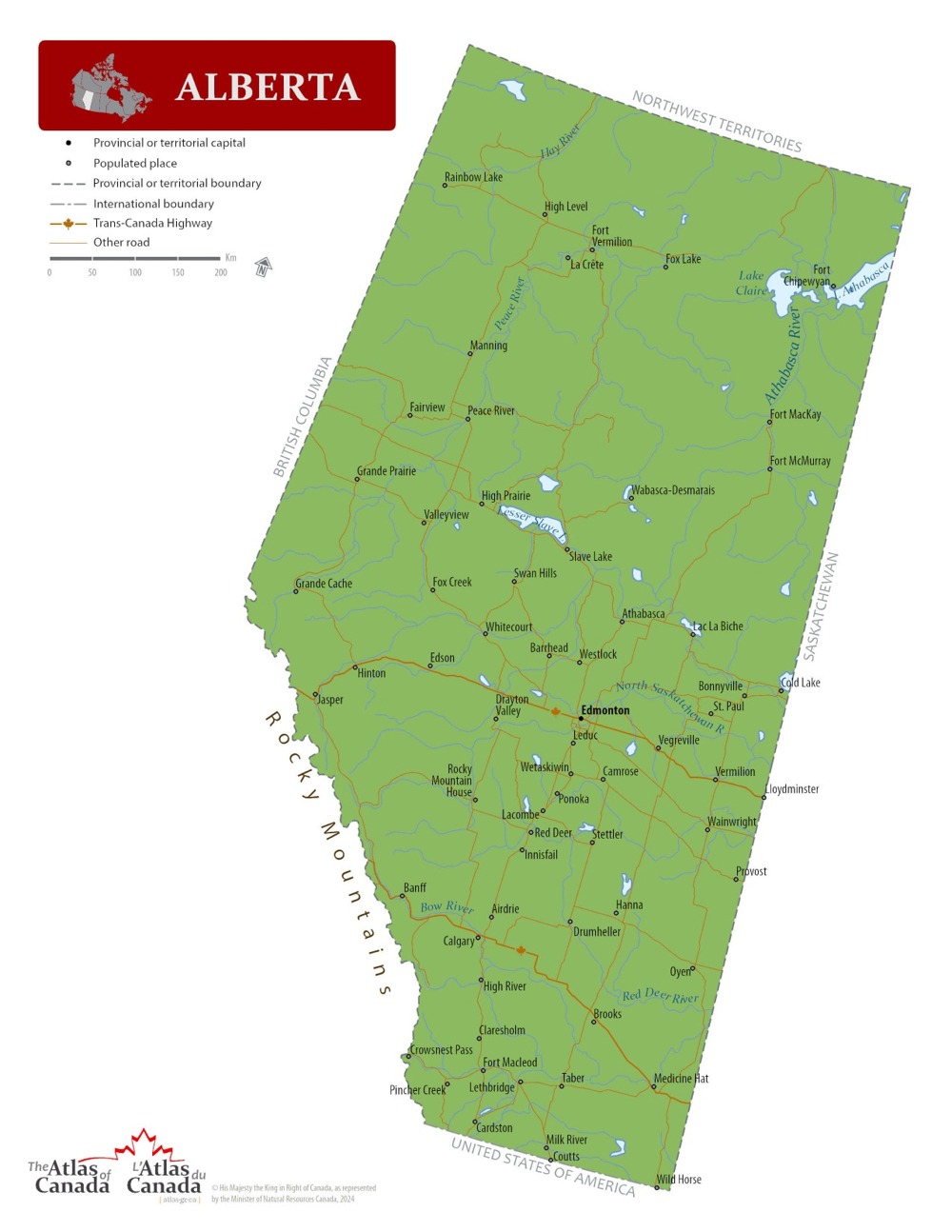
Map © Natural Resources Canada / Government of Canada
Alberta — Interactive Map
Explore Alberta with an interactive map featuring Street View, satellite and terrain views. Live weather, local news and location details for Alberta — built for travel planning and emergencies.
Map search is available for a limited number of queries per session to manage costs. Be specific — search precisely for best results.
| Province / Territory | Alberta (AB) |
| Capital | Edmonton |
| Largest City | Calgary |
| Country | Canada |
| Nickname | Wild Rose Country |
| Latitude | 53.9333 |
| Longitude | -116.5765 |
| Population | 4,262,635 |
| Cities & Towns | 1,623 |
| Area | 661,848 km² |
About Alberta
Alberta encompasses a vast, dramatic expanse where the serrated peaks of the Rocky Mountains give way to the sprawling, golden wheat fields of the prairies. To the north, the boreal forest stretches toward the horizon in a dense, emerald mantle, while the central region acts as a transitional corridor of parkland and rolling foothills. Glacial-fed rivers carve deep, limestone-walled canyons through the landscape, feeding into the great drainage basins that define the provincial watershed. The climate swings between the sharp, crystalline cold of long winters and the intense, sun-drenched brightness of brief, verdant summers. Alberta maintains a rugged physical grandeur that shifts from the high-altitude wilderness of Jasper and Banff to the arid, prehistoric badlands of the south. This terrain demands a certain resilience from all living things, shaped by the relentless wind and the dramatic seasonal shifts in light.
Indigenous peoples have served as the traditional custodians of these lands for millennia, their presence marked by ancient trails and sites of deep cultural significance that predate the arrival of European explorers. Following the arrival of fur traders and the eventual expansion of the railway, Alberta became a frontier for homesteaders who sought to break the soil and build communities in a challenging climate. The transition from a district within the North-West Territories to a distinct province occurred during the early twentieth century, an era defined by rapid infrastructure development and the migration of families from across the globe. History here is marked by the steady, persistent effort to transform a remote wilderness into a structured society while respecting the deep roots of those who occupied the territory first. Alberta retains the spirit of this early settlement period, visible in the architecture of its rural towns and the expansive, grid-like layout of its agricultural heartland.
Resource extraction serves as the primary engine of the economy in Alberta, with the energy sector playing a vital role in the prosperity of its citizens. Beyond the oil sands and the sprawling networks of pipelines, the province boasts a robust agricultural sector that produces immense quantities of grains, pulses, and livestock for global markets. Calgary and Edmonton act as the twin poles of this commercial activity, each functioning as a sophisticated regional hub for technology, finance, and logistics. Manufacturing and forestry further diversify the economic landscape, ensuring that Alberta remains a powerhouse of production and innovation. The provincial identity is inextricably linked to this industrious nature, where the drive to develop natural wealth is balanced by a constant search for new economic frontiers. Success in Alberta often mirrors the scale of its geography—ambitious, expansive, and perpetually focused on the horizon.
Identity in Alberta finds its truest expression in the shared passion for professional sports, where the fierce rivalries of the NHL and the grit of the CFL define the community spirit during the long winter months. Annual events like the Calgary Stampede transform the urban environment into a celebration of heritage, music, and ranching culture that draws visitors from every corner of the earth. Culinary traditions here lean toward the hearty and the local, highlighting high-quality beef and the bounty of prairie-grown produce. Cultural landmarks, from grand performing arts theatres to modest museums in small towns, document the evolving nature of life in the north. The rhythm of daily existence is steady and direct, reflecting a population that values plain speaking and the quiet satisfaction of a job well done. Alberta fosters a unique blend of cosmopolitan ambition and a profound, enduring connection to the wild, open spaces that surround its inhabitants.
Alberta Cities, Towns and Communities
A
B
C
D
E
F
G
H
I
J
K
L
M
N
O
P
Q
R
S
T
V
W
Y
Alberta Maps — Interactive Map, Street View, Weather & News
This page provides an interactive Google map of Alberta (AB) with Street View, satellite and terrain views, alongside links to detailed street maps for 1,623 cities, towns and communities across the province. The provincial capital is Edmonton.
Every location page includes live weather through Open-Meteo — with current conditions, hourly outlooks and 7-day forecasts — alongside real-time local and world news feeds. Editorial summaries and location descriptions are included where available, and visitors can search Google directly from each page for additional context.
The Search Maps button below the map opens the Canada Base Map with Toporama contours and shaded relief as base layers, with a labelled UTM grid overlay, a distance and bearing tool, and a single-fix GPS readout giving your UTM/MGRS grid reference and latitude and longitude.
Location data is sourced from the Canadian Geographical Names Database (CGN), Natural Resources Canada, and verified by coordinates rather than name matching alone.