A large detailed map of Nova Scotia
This is a large, detailed map of Nova Scotia. There are links to many Nova Scotia localities below. Our website format reduces the display size for uniformity. Here is a link to the full-size image that is more easily readable.
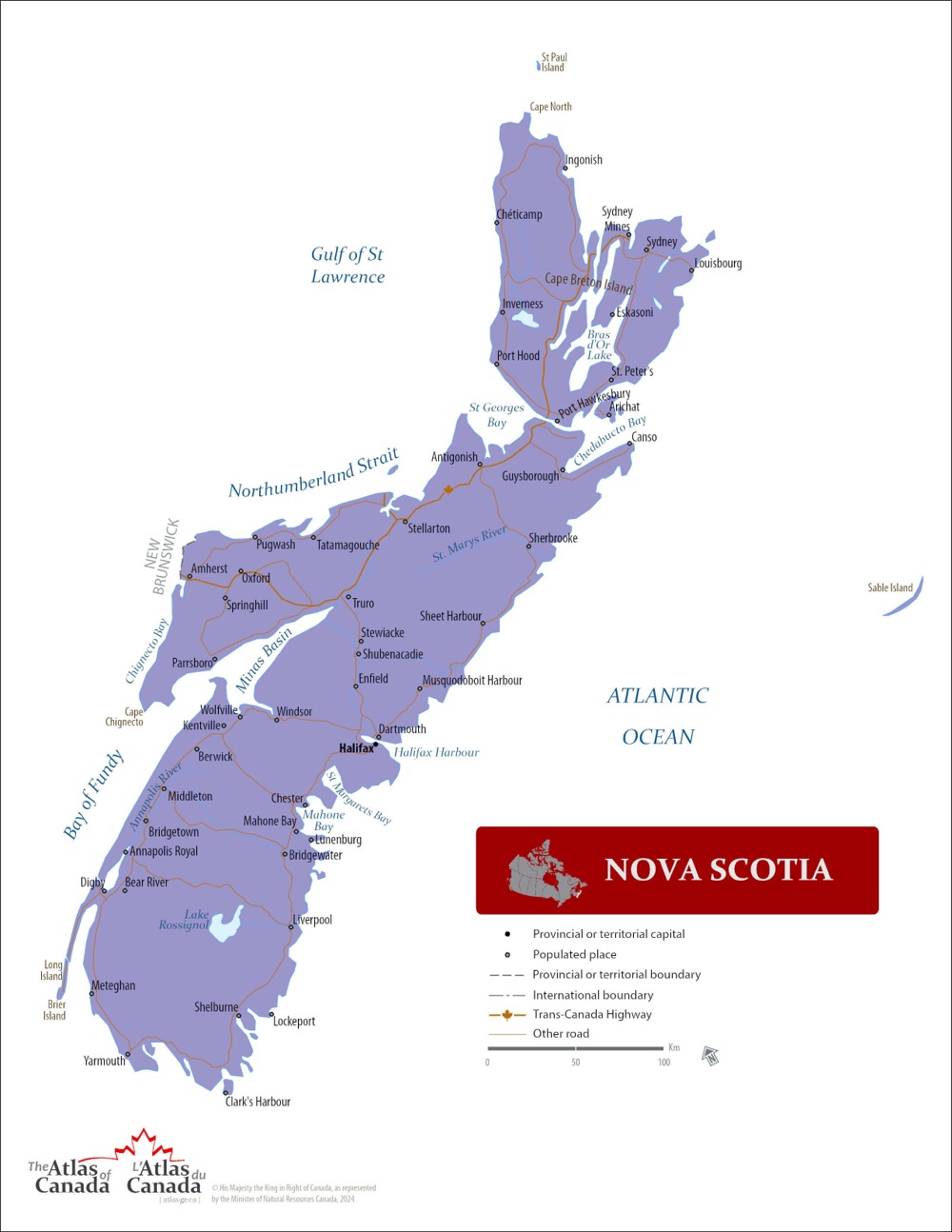
Map © Natural Resources Canada / Government of Canada
Nova Scotia — Interactive Map
Explore Nova Scotia with an interactive map featuring Street View, satellite and terrain views. Live weather, local news and location details for Nova Scotia — built for travel planning and emergencies.
Map search is available for a limited number of queries per session to manage costs. Be specific — search precisely for best results.
| Province / Territory | Nova Scotia (NS) |
| Capital | Halifax |
| Largest City | Halifax |
| Country | Canada |
| Nickname | Canada’s Ocean Playground |
| Latitude | 44.682 |
| Longitude | -63.7443 |
| Population | 969,383 |
| Cities & Towns | 2,642 |
| Area | 55,284 km² |
About Nova Scotia
Nova Scotia extends into the Atlantic like a granite hand, defined by the relentless meeting of rock and salt water. The terrain rises from the low-lying Annapolis Valley to the rugged, ancient highlands of the north, where wind-swept barrens offer a stark contrast to the dense, spruce-filled forests of the interior. Numerous rivers vein the land, carved into the bedrock and feeding the deep, sheltered bays that define the jagged coastline. In the centre of the landmass, the climate shifts between continental chill and the moderating, humid breath of the ocean, creating a landscape that remains perpetually damp and moss-covered. Provincial parks protect the integrity of these wild spaces, preserving the quietude of inland lakes and the dramatic, crashing surf of the Atlantic face. Nova Scotia carries a physical weight in its stones, a density that seems to hold the very memory of the tides.
Indigenous peoples have moved across this land for millennia, their presence marked by ancient paths and the enduring names of water and wood. Later, European ships arrived to establish outposts of defence and trade, turning the deep harbours into vital nodes for colonial expansion. Nova Scotia evolved through cycles of conflict and migration, as settlers from across the Atlantic sought a new life on this rocky edge of the continent. The architecture of the region reflects these layers of history, from fortified stone citadels overlooking the water to the humble wooden saltboxes that dot the coastal roads. Over generations, the province solidified its identity as a maritime gateway, balancing the influence of distant empires with the practical demands of life on the edge of the sea. Nova Scotia retains a distinct character shaped by these waves of arrival, where the past is never buried but remains a visible part of the present horizon.
Economic life in Nova Scotia draws its strength from the cold, nutrient-rich waters of the Atlantic and the fertile soil of its sheltered basins. Fishing remains a primary pillar of the regional identity, with fleets harvesting lobster, scallops, and groundfish to supply global markets. Agriculture flourishes in the warmer valleys, where orchards and vineyards benefit from a unique microclimate that produces crisp, cool-climate wines. Beyond these primary resources, the service sector and manufacturing industries in urban centres provide the momentum for growth and innovation. Tourism draws visitors to the rugged coasts, where the quiet beauty of small fishing villages sustains a steady flow of commerce throughout the summer months. Nova Scotia manages to balance these traditional industries with modern technological sectors, ensuring that the economy remains as resilient as the people who inhabit the coastline.
Daily life in Nova Scotia follows the pulse of the tides and the shifting seasons, rooted in a culture that values community and the endurance of tradition. Festivals celebrate the Celtic and Acadian heritage of the region, filling the harbours with the sound of fiddles and the smell of woodsmoke. While the province does not host major professional teams in the largest North American leagues, local pride is fiercely invested in university athletics and community-level sports that bring towns together on Saturday afternoons. The culinary scene reflects the bounty of the land and sea, featuring fresh seafood and local produce that define the home-grown palate. People here move with a deliberate purpose, finding contentment in the small, recurring rituals of coastal living. Nova Scotia offers a sense of stability, a place where the connection to the natural world dictates the rhythm of the year and the character of every neighbour.
Nova Scotia Cities, Towns and Communities
A
B
C
D
E
F
G
H
I
J
K
L
M
N
O
P
Q
R
S
T
U
V
W
Y
Nova Scotia Maps — Interactive Map, Street View, Weather & News
This page provides an interactive Google map of Nova Scotia (NS) with Street View, satellite and terrain views, alongside links to detailed street maps for 2,642 cities, towns and communities across the province. The provincial capital is Halifax.
Every location page includes live weather through Open-Meteo — with current conditions, hourly outlooks and 7-day forecasts — alongside real-time local and world news feeds. Editorial summaries and location descriptions are included where available, and visitors can search Google directly from each page for additional context.
The Search Maps button below the map opens the Canada Base Map with Toporama contours and shaded relief as base layers, with a labelled UTM grid overlay, a distance and bearing tool, and a single-fix GPS readout giving your UTM/MGRS grid reference and latitude and longitude.
Location data is sourced from the Canadian Geographical Names Database (CGN), Natural Resources Canada, and verified by coordinates rather than name matching alone.